Solar Shades
A technical mesh that cuts glare and UV while preserving the view through the window. Rated by openness factor — the lower the percentage, the more glare control and the less you see through.
One clean panel of fabric, chosen for exactly how much light you want to keep out.
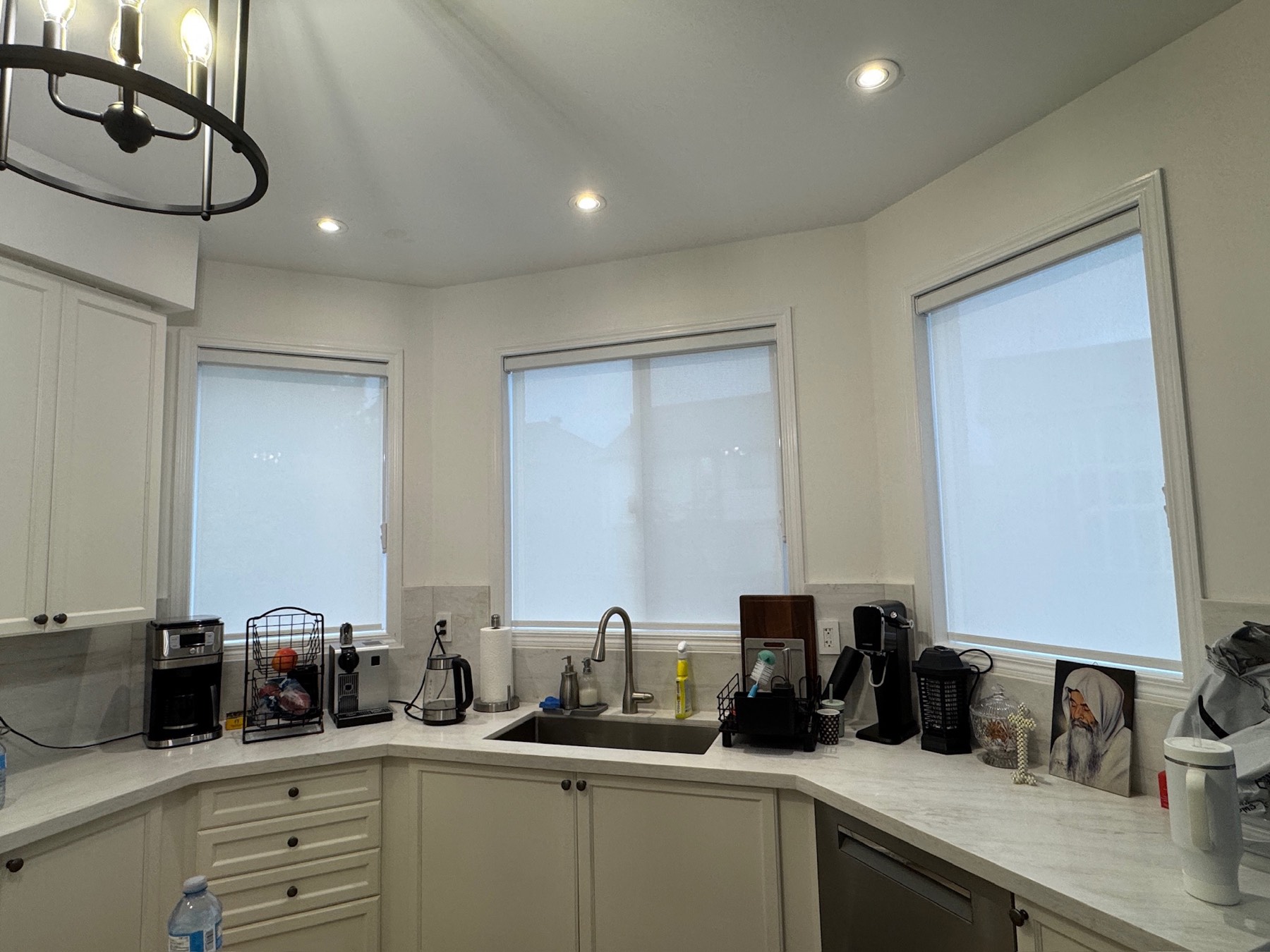
Where blinds give you slats, shades give you a single uninterrupted panel. That makes them the quieter choice visually — they read as part of the wall rather than as hardware — and it makes them far better at the two extremes: total blackout, or cutting glare while keeping the view.
Choosing a shade is really choosing a fabric. Openness factor, weave, and lining determine whether you end up with a room that is genuinely dark at 7am in June, or one that merely feels dim. We bring the samples to you and show them against your own window, because fabric behaves differently depending on which way the glass faces.
Arranged roughly from most light to least, so you can find where on the spectrum your room sits.
A technical mesh that cuts glare and UV while preserving the view through the window. Rated by openness factor — the lower the percentage, the more glare control and the less you see through.
Alternating sheer and opaque bands that slide over one another. Align them for a clear view, offset them for privacy, all without raising the shade. The most versatile option we sell.
The simplest and most durable system: one panel on one tube. Available in almost any fabric, from light-filtering to fully opaque.
An opaque fabric with an added blocking layer. Paired with side channels or a generous overlap, this is the only configuration that delivers genuine darkness.
A pleated cell structure that traps air against the glass. The best insulator we install, which makes a measurable difference on older windows through a Canadian winter.
Fabric that folds into soft horizontal pleats as it raises. The most decorative option, and the one that most reads as drapery rather than hardware.
A roller shade is one panel of fabric. A zebra shade has alternating sheer and opaque horizontal bands on a single loop, so sliding it slightly changes the window from view-through to private without raising anything. Zebra costs more, and is worth it on windows where you change your mind through the day.
Only with the right configuration. The fabric itself blocks the light, but a standard install leaves a gap at the sides where light spills in. Adding side channels or an outside mount with generous overlap is what produces genuine darkness. We will specify that if you tell us the room is for shift work or a nursery.
On older or single-glazed windows, noticeably. The cells trap a layer of air against the glass and reduce heat transfer both ways. On new triple-glazed windows the benefit is much smaller, and we will say so rather than upsell you.
For a home office where screen glare is the problem, 1-3% works best. For a living room where you want to keep the view, 5-10%. Openness also affects privacy after dark, when interior light reverses the effect and makes the room visible from outside.
Yes, every shade type we supply is available motorised, with battery, hardwired, or solar-charged power. See our motorization page for the detail.
Free in-home consultation. No pressure, no obligation. Just expert advice and a quote you can trust.